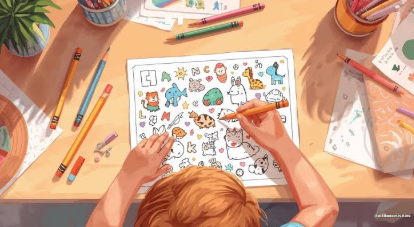
The Busywork Myth That Won’t Go Away
Most teachers and parents treat coloring sheets as a filler activity, something to hand out when the lesson plan runs short or a classroom needs five quiet minutes before lunch. The assumption is that coloring doesn’t teach anything beyond staying inside the lines, and that real learning happens elsewhere, during reading time or math drills. That view has stuck around for decades, partly because coloring looks passive compared to flashcards or worksheets with clear right and wrong answers.
The trouble with that assumption is that it ignores what’s actually happening while a child colors. Fine motor control, color recognition, pattern matching, and sustained attention are all being exercised, even if the child thinks they’re just making a lion purple. Early childhood specialists have pushed back on the busywork label for years, pointing out that repetitive, low-stakes creative tasks build neural pathways that structured lessons don’t reach the same way. Dismissing coloring as filler overlooks a developmental function that’s easy to miss because it doesn’t produce a test score.
Why Subject Matter Changes the Learning Outcome
Not all coloring sheets carry the same educational weight, and this is where the busywork argument starts to fall apart. A generic geometric pattern asks a child to focus on motor skills alone, but a page built around a specific subject, like wildlife, plants, or historical scenes, adds content recognition that keeps a young learner’s brain working on two tracks at once. Teachers who’ve shifted toward themed coloring activities often report that kids retain vocabulary and facts tied to the images longer than facts delivered through lecture alone.
This is especially true with nature-based content, where repeated exposure to shapes and species builds a visual vocabulary before a child can read fluently. Sets built around animal coloring pages work well here because they pair recognizable creatures with enough detail to prompt questions, like why a zebra has stripes or how a frog breathes underwater, without overwhelming a five-year-old’s attention span. That kind of incidental curiosity is difficult to manufacture through a worksheet with blanks to fill in.
The format also matters for kids who struggle with traditional instruction. A child who shuts down during a phonics drill may stay engaged with an animal-themed page for twenty minutes, absorbing names, habitats, and physical traits along the way. That engagement gap shows up in arts education literature, and National Endowment for the Arts research has tracked similar patterns in how creative activity correlates with sustained attention and classroom participation among young children.
Building a Rotation That Does More Than Fill Time
Turning coloring into a genuine teaching tool starts with intention rather than convenience. Instead of grabbing whatever sheet is nearest when a class needs five quiet minutes, it helps to tie the subject matter to whatever unit is already in progress, whether that’s ocean life, farm animals, or insects. This turns a filler activity into reinforcement, giving kids a second exposure to vocabulary and concepts they just learned through a book or video.
Rotation matters too. Repeating the same handful of images week after week dulls the novelty that keeps kids curious, so cycling through new subjects keeps engagement higher over a full semester. Pages with varying levels of detail also let teachers differentiate without much extra planning, giving younger students simpler outlines while older kids get more intricate scenes that demand longer focus.
The last piece is conversation. A coloring page left to speak for itself still teaches something, but pairing it with a few questions while kids work, asking what sound an animal makes or where it lives, turns a quiet activity into a low-pressure discussion. Teachers who build this habit tend to notice kids retaining details weeks later, long after the page has been taped to a refrigerator. The goal isn’t to make coloring feel like a quiz, but to use the quiet, focused state kids enter while coloring as a window for learning that doesn’t stick when it’s delivered under pressure.